Ship in Europe, Find out rates!
Language

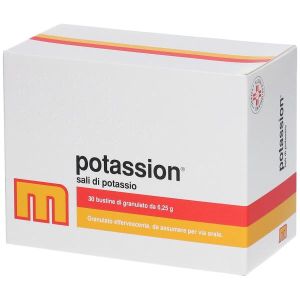
Acarpia Potassion Potassium Salts Food Supplement 30 Sachets
Regular Price
€18.00
Special Price
€17.38
-3%
Save: €0.62
In stock
Recent lowest price:
€17.55
Delivery 48/72h
Free returns
+80,000 products
Secure payments
Original products
Verified reviews
Potassion Os 20 Bustine Granulato Effervescente
Manufacturer
ACARPIA FARMACEUTICI
SKU
009209053
Active principle
POTASSIO CITRATO/POTASSIO SUCCINATO/POTASSIO MALATO/POTASSIO TARTRATO/POTASSIO BICARBONATO
NAME
POTASSION - POTASSIUM SALTS
PHARMACOTHERAPEUTIC CATEGORY
Potassium.
ACTIVE PRINCIPLES
1 single-dose sachet contains: potassium succinate 0.100 g (equal to 0.0401 g of K ^ + corresponding to mEq 1.03), malate potassium 0.100 g (equal to 0.0370 g of K ^ + corresponding to mEq 0.95), potassium citrate 0.250 g (equal to g 0.0954 of K ^ + corresponding to mEq 2.45), potassium tartrate 0.050 g (equal to g 0.0172 of K ^ + corresponding to mEq 0.44), potassium bicarbonate 0.500 g (equal to g 0.1947 of K ^ + corresponding to mEq 4.99).
EXCIPIENTS
Tartaric acid, lemon essence, raspberry essence, sucrose.
INDICATIONS
States of potassium deficiency, even in the course of acidosis as an alkalizing therapy.
CONTRAINDICATIONS / SECONDARY EFFECT
States of hyperkalaemia of various causes (systematic acidosis including diabetic, renal insufficiency, states of intense and rapid dehydration, severe burns, haemolysis, crush syndrome or other affections involving extensive tissue necrosis, adrenocortical insufficiency, administration of potassium-sparing diuretics). All solid preparations containing potassium salts are contraindicated in subjects with disorders of the canalization of the gastrointestinal tract.
DOSAGE
Adult dose: 1 to 8 sachets or more per day, according to medical prescription. Children's dose: according to medical prescription. One sachet provides 1 g of potassium salts equal to 0.384 g of potassium ion equivalent to 10 mEq. The granules contained in the sachets can be taken without water and chewed little by little: or it can be drunk dissolved in a little water, according to preference. Take after meals.
STORAGE
No special storage precautions.
WARNINGS
The use of the preparation in the therapy of potassium depletion must be evaluated and controlled (especially in subjects with chronic kidney disease) on the basis of the data provided by the ionogram, the measurement of blood pH and ECG. Signs of overdose require discontinuation of treatment and the adoption of adequate therapeutic measures. Any concomitant changes in the acid-base and hydroelectrolytic equilibrium must also always be present, both for the choice of the salt to be used and for the variations in kalaemia and for states of acidosis or alkalosis which in themselves involve moving the cation from the cellular to the interstitial compartment. and viceversa. To avoid the effects of potassium salts on the mucous membrane of the digestive system, it is recommended to take the product diluted in water or after meals. The product contains sucrose. This should be taken into account in the treatment of diabetic patients and subjects maintained on a low-calorie diet. Keep out of the reach and sight of children.
INTERACTIONS
It is advisable not to administer potassium salts and potassium-sparing diuretics at the same time. In cardiopathic patients, the electrophysiological effects of antiarrhythmic products can be enhanced or depressed by a state of hyperkalaemia and hypokalaemia, respectively.
SIDE EFFECTS
Frequencies of adverse reactions: very common (> = 1/10), common (> = 1/100, <1/10), uncommon (> = 1 / 1,000, <1/100), rare (> = 1 / 10,000 , <1 / 1,000), very rare (<1 / 10,000), not known. Frequency not known: nausea; He retched; abdominal pain; diarrhea; bleeding; ulcerations, perforations and intestinal strictures. Report any suspected adverse reactions via the national reporting system.
PREGNANCY AND BREASTFEEDING
No particular precaution is foreseen in the circumstance.
POTASSION - POTASSIUM SALTS
PHARMACOTHERAPEUTIC CATEGORY
Potassium.
ACTIVE PRINCIPLES
1 single-dose sachet contains: potassium succinate 0.100 g (equal to 0.0401 g of K ^ + corresponding to mEq 1.03), malate potassium 0.100 g (equal to 0.0370 g of K ^ + corresponding to mEq 0.95), potassium citrate 0.250 g (equal to g 0.0954 of K ^ + corresponding to mEq 2.45), potassium tartrate 0.050 g (equal to g 0.0172 of K ^ + corresponding to mEq 0.44), potassium bicarbonate 0.500 g (equal to g 0.1947 of K ^ + corresponding to mEq 4.99).
EXCIPIENTS
Tartaric acid, lemon essence, raspberry essence, sucrose.
INDICATIONS
States of potassium deficiency, even in the course of acidosis as an alkalizing therapy.
CONTRAINDICATIONS / SECONDARY EFFECT
States of hyperkalaemia of various causes (systematic acidosis including diabetic, renal insufficiency, states of intense and rapid dehydration, severe burns, haemolysis, crush syndrome or other affections involving extensive tissue necrosis, adrenocortical insufficiency, administration of potassium-sparing diuretics). All solid preparations containing potassium salts are contraindicated in subjects with disorders of the canalization of the gastrointestinal tract.
DOSAGE
Adult dose: 1 to 8 sachets or more per day, according to medical prescription. Children's dose: according to medical prescription. One sachet provides 1 g of potassium salts equal to 0.384 g of potassium ion equivalent to 10 mEq. The granules contained in the sachets can be taken without water and chewed little by little: or it can be drunk dissolved in a little water, according to preference. Take after meals.
STORAGE
No special storage precautions.
WARNINGS
The use of the preparation in the therapy of potassium depletion must be evaluated and controlled (especially in subjects with chronic kidney disease) on the basis of the data provided by the ionogram, the measurement of blood pH and ECG. Signs of overdose require discontinuation of treatment and the adoption of adequate therapeutic measures. Any concomitant changes in the acid-base and hydroelectrolytic equilibrium must also always be present, both for the choice of the salt to be used and for the variations in kalaemia and for states of acidosis or alkalosis which in themselves involve moving the cation from the cellular to the interstitial compartment. and viceversa. To avoid the effects of potassium salts on the mucous membrane of the digestive system, it is recommended to take the product diluted in water or after meals. The product contains sucrose. This should be taken into account in the treatment of diabetic patients and subjects maintained on a low-calorie diet. Keep out of the reach and sight of children.
INTERACTIONS
It is advisable not to administer potassium salts and potassium-sparing diuretics at the same time. In cardiopathic patients, the electrophysiological effects of antiarrhythmic products can be enhanced or depressed by a state of hyperkalaemia and hypokalaemia, respectively.
SIDE EFFECTS
Frequencies of adverse reactions: very common (> = 1/10), common (> = 1/100, <1/10), uncommon (> = 1 / 1,000, <1/100), rare (> = 1 / 10,000 , <1 / 1,000), very rare (<1 / 10,000), not known. Frequency not known: nausea; He retched; abdominal pain; diarrhea; bleeding; ulcerations, perforations and intestinal strictures. Report any suspected adverse reactions via the national reporting system.
PREGNANCY AND BREASTFEEDING
No particular precaution is foreseen in the circumstance.
| Destination | Cost | Detail |
|---|---|---|
| Italy | €5,00* | 72H |
| ZONE 1 | € 9,90* | 3 days |
| ZONE 2 | € 13,90* | 4 days |
| ZONE 3 | € 16,90* | 5 days |
| ZONE 4 | € 19,90* | 5 days |
| United Kingdom, Switzerland4 | € 30* | 7 days |
| Canada, USA | € 45 | 7 Days |
European shipments with express courier: FedEx, MBE, DHL
*For the shipment outside band B ther's an extra cost of 22€ *For the shipment outside band C ther's an extra cost of 30€ Delivery Times exclude Saturday and Holidays
For Islands and Areas of difficult Accessibility the shipments are made in 72 hours and the cost will be increased by 15€
The images of the products shown on our site are purely indicative and may differ in shape, color, text and packaging shown on them. Given the difficulty of updating all the products on our site in real time or any errors, XFarma.it, all products will be identified through SKU MINSAN (code of the Ministry of Health).